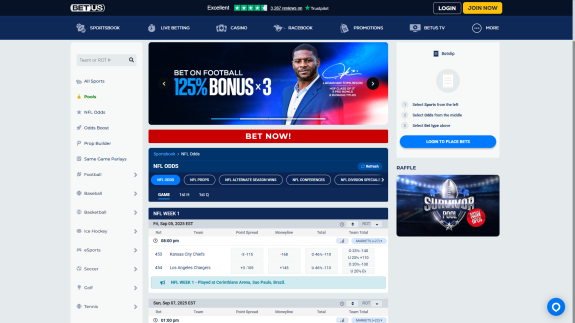
18+. Full T&C's apply. Sports bonus: 100% match up to $500. Casino bonus: 100% match up to $500. Enter promo code NEW200 at deposit and get up to a $1000 bonus. Valid on your first three (3) deposits. Available for all deposit methods. Minimum deposit of $50.
18+. Full terms apply. The Bet Back Bonus is available for new customers on first-time deposits of $50 or more. To redeem, select the offer in the cashier while completing your first deposit. Make your pick(s) in the Sportsbook and then select ‘Opt In to Use Your Bonus’. A Bet Back Bonus pop-up will display, select ‘Claim’ and then enter the risk amount to place your bet. If it wins, you keep your profits. If it loses, get 100% of your risk refunded as Free Play with only 1-time rollover. Free Play can then be used to place bets in the Sportsbook and earn cash. Additional T&Cs apply, please visit MyBookie to access the Help Center or contact Live Chat for more details.
Moving broadcast footage played inside the sportsbook’s website or app. This is the only feature that qualifies as sportsbook live streaming here.
Live scores
Score, clock, period, possession, and incident updates delivered as data. They may refresh quickly without showing any video.
Match visualization
An animated pitch, court, or tracker reconstructed from event data. It represents the action rather than broadcasting it.
Live commentary
Text or audio descriptions of play as it happens. Commentary can accompany video, but it is not a video stream by itself.
In-play wagering
Markets that remain open and change during an event. Betting can be live even when no footage is available.
The basic distinction
A video player is the dividing line
Live data and live wagering do not guarantee live footage.
The clearest test is simple: does the event page contain a player showing actual broadcast footage? If it only displays a scoreboard, animated tracker, written updates, odds movements, or a link that opens a television provider elsewhere, the sportsbook is not streaming that fixture.
This distinction matters because live betting platforms often place several real-time features together. A changing clock and rapidly suspended markets can make a page feel like a broadcast experience, although the operator is supplying data and wagers rather than pictures.
Rights are decided fixture by fixture
Video availability is mainly controlled by territorial broadcast and streaming rights. An operator may have permission to show one tennis tournament in a country but not another, or selected lower-profile football matches while a domestic broadcaster controls the major league. Rights can also vary by competition round, language, device, and whether the viewer is at home or travelling.
Cryptocurrency support does not alter those agreements. Bitcoin or stablecoin deposits describe how an account can be funded; they do not grant the sportsbook permission to distribute a video feed. A crypto-focused operator and a conventional sportsbook may therefore show the same fixture—or both may be unable to show it—depending on their rights in that location.
A broadcaster logo or “watch” button should also be checked carefully. It may lead to an external subscription service rather than open an embedded stream. Genuine availability becomes clear only when the event page loads a playable video window and any location or account checks have been satisfied.
Regional access
Location can block the stream
Licensing and broadcast rights often stop at regional borders.
A sportsbook may operate in several countries while holding streaming rights in only some of them. Restrictions can be narrower still: a service licensed in one US state or Canadian province may offer a different event list, video player, or account setup across the border. Crypto deposits do not override those boundaries.
Platforms typically check location through an IP address, device location services, account details, and sometimes specialist geolocation software. A user can therefore see an event in the betting lobby but lose the video button after signing in or attempting playback. Travel can also change access, even when the same account and device are used.
Local broadcast agreements add another layer. If a television network or streaming service has exclusive rights in a territory, the sportsbook feed may be unavailable there despite working elsewhere. Blackouts can apply to individual matches rather than an entire league.
Before relying on live video, it helps to verify:
the sportsbook’s licensed regions and accepted residence locations;
whether streaming terms mention the specific country, state, or province;
any event-level blackout message after login;
location permissions required by the app or browser.
Reviews, forum posts, and screenshots from another region are not proof of local availability. They may reflect different rights, regulations, or an older agreement.
A VPN is not a dependable workaround. Geolocation systems may detect it, block playback, request additional verification, or restrict the account. Using one to bypass territorial controls may also breach the sportsbook’s terms and complicate withdrawals.
Viewer eligibility
Account access is only the first check
Playback may depend on verification, funds, or a bet
A stream that appears in the event listing may remain locked until the account meets the operator’s viewing rules. These conditions are not universal: one sportsbook may allow playback after login, while another requires several additional checks.
Common requirements include:
A registered, logged-in account in an eligible jurisdiction.
Completed age or identity verification, especially where regulations require it before gambling features become available.
A positive account balance, sometimes with no stated minimum beyond a small amount.
A qualifying wager, which may need to be placed on that event or exceed a minimum stake.
The wording matters. “Funded account” may include deposited cash but exclude bonus funds, while “bet placed” may refer only to settled funds or specific markets. Requirements can also change by sport, competition, or broadcast partner, so the event page and streaming terms are more reliable than a general feature list.
Video access should also be separated from other live-betting tools. Being allowed to watch does not guarantee that odds will update, bets can be placed in play, or a position can be closed early. The rules governing when cash out is offered are typically based on market status and operator risk controls, not streaming eligibility.
During play
Why a stream can change mid-event
Availability and playback are not guaranteed from start to finish.
A stream often appears only a few minutes before the scheduled start and may end immediately after the event. Delays, postponements, venue changes, or an event being abandoned can prevent the player from appearing at all. Some feeds also pause during intervals when the rights package excludes studio coverage or advertising breaks.
Rights can change the picture after playback has begun. A broadcaster may withdraw a feed, enforce a newly detected location restriction, or provide video for only part of a tournament. Lower-profile events are especially dependent on the local production crew, so missing cameras, power problems, or an interrupted uplink can leave a blank player.
Market suspension is different
A frozen or suspended betting market does not necessarily mean the video has failed. Sportsbooks routinely stop accepting bets around goals, penalties, reviews, injuries, or other moments likely to move prices. The stream may continue normally while selections are locked; the reasons live betting gets suspended are tied mainly to pricing and risk control.
The reverse can happen too: odds may keep updating while the video buffers or disappears. Common playback failures include overloaded servers, unstable connections, expired sessions, and unsupported browser settings.
Most importantly, streaming footage is delayed—sometimes by several seconds or more—while odds may react to a faster data feed. Video should therefore not be treated as a synchronized guide to live prices. Refreshing the player rarely closes that gap and can increase it.
Playback differences
Why one device plays and another does not
The same account can receive different results across an app and browser.
A working stream in the mobile app may fail in a desktop browser, or vice versa. Sportsbooks often support only certain operating-system and browser versions, while protected video may depend on DRM components such as Widevine or FairPlay. An outdated browser, private-browsing mode, or disabled protected-content setting can leave the betting page functional but the video panel blank.
Browser autoplay rules can also stop playback until the video is tapped or unmuted. In an app, missing location, network, or media permissions may prevent the stream from starting. A weak mobile connection can produce endless buffering even though odds continue updating, because video requires far more bandwidth than market data.
Another device may already be using the account’s permitted stream. Some operators allow only one concurrent broadcast, so an abandoned tab, smart TV, or second phone can quietly block playback.
A sensible recovery order
Refresh or restart the page or app, then close any other active streams.
Confirm the login and location check. Reauthentication may be required after changing networks.
Switch platforms. Try the current sportsbook app, a supported browser, or an updated operating system; enable protected content and necessary permissions.
Test the connection. Move from unstable mobile data to reliable Wi-Fi, without using tools that interfere with location checks.
If the account and event should qualify, contact support while the live wager is active. Include the event, device, operating system, error message, and approximate failure time.
Capture the error before switching devices
A screenshot and exact error code can distinguish a rights restriction from a technical playback fault. That matters when the event may end before ordinary support responds.
Before depositing
Check whether the advertised stream will actually open
Match the exact fixture
Confirm the teams or players, competition, date, and scheduled start time. Similar names, reserve teams, women’s competitions, and regional tournaments can easily be mistaken for the advertised event.
Look for a video marker
Open the event page rather than relying on a general sports list. A play icon or explicit “live stream” label is stronger evidence than live scores, commentary, or a pitch graphic.
Verify local and account eligibility
Check that streaming is permitted in the account’s registered country and current location. Verification status, age checks, account restrictions, and local blackout rules may also determine access.
Read the qualification terms
Find out whether the player needs a positive cash balance, a minimum deposit, or a settled or open wager. The qualifying amount, eligible markets, and whether bonus funds count should be stated clearly.
Check when the player appears
Some streams are not displayed until a few minutes before play begins. Support should be able to confirm the launch window for the specific fixture—not merely say that the sport is covered.
Confirm device compatibility
Check the supported browser, app, operating system, DRM requirements, and simultaneous-stream limits. Broader crypto sportsbook comparisons are more useful when they include these practical access details alongside payment options.
Screenshots or written confirmation from support can help if the published conditions are unclear.
A large catalog proves very little
Claims such as “thousands of live events” describe overall inventory, not guaranteed access to one fixture. Coverage can differ by territory, account, device, and match; rights may also change after the catalog was advertised.
Decision rule
Choose verified access, not a crypto badge
A deposit is worth considering only when the exact event is locally available, the account can qualify on acceptable terms, and a supported device can play it near the scheduled start. Conditions should be visible and specific.
If coverage or eligibility remains vague, cryptocurrency support is not a reason to fund the account. Transparent streaming rules matter more than the payment rail.
Top Crypto Sportsbooks for October 2026
BetUS
200% up to $1,000
Code: NEW200
18+. Full T&C's apply.
18+. Full T&C's apply. Sports bonus: 100% match up to $500. Casino bonus: 100% match up to $500. Enter promo code NEW200 at deposit and get up to a $1000 bonus. Valid on your first three (3) deposits. Available for all deposit methods. Minimum deposit of $50.
18+. Full terms apply. The Bet Back Bonus is available for new customers on first-time deposits of $50 or more. To redeem, select the offer in the cashier while completing your first deposit. Make your pick(s) in the Sportsbook and then select ‘Opt In to Use Your Bonus’. A Bet Back Bonus pop-up will display, select ‘Claim’ and then enter the risk amount to place your bet. If it wins, you keep your profits. If it loses, get 100% of your risk refunded as Free Play with only 1-time rollover. Free Play can then be used to place bets in the Sportsbook and earn cash. Additional T&Cs apply, please visit MyBookie to access the Help Center or contact Live Chat for more details.
Tony is the founder and author behind Betting52, where he writes about crypto sports betting, offshore sportsbooks and the wider world of online sports betting. His work covers crypto sportsbook reviews, Bitcoin and cryptocurrency payment methods, betting bonuses, sportsbook comparisons, betting odds, markets and practical betting guides. Tony's aim is to make sports betting information easier to understand, helping readers research sportsbooks, compare their options and make more informed decisions before placing a bet. Alongside sportsbook and crypto betting content, he is interested in the technology, payment systems and security considerations shaping the future of online sports betting.