How to Navigate Regulation and Licensing
A bettor sits at a kitchen table with two browser tabs open — one flashing a crypto welcome bonus, the other a government license lookup — and pauses before pasting a wallet address. That pause is where regulation and licensing stops feeling like paperwork and starts acting like bankroll protection.
If a headline like BetUS 200% Crypto sign-up Bonus up to $2,750 - Go betus crypyo bonus pulls you in, good. Now slow down for one minute. A big offer can still sit on top of the wrong jurisdiction, an expired record, or a regulator file you would never like if you actually opened it.
Top Crypto Offers for August 2026



Prerequisites: gather the right tools for regulation and licensing before you compare offers
Start with official sources and a simple checklist. You are trying to separate marketing from evidence.
- A browser with official regulator pages open
- A notes app or notebook
- The operator name, terms page, and promo page
- Your current location, because local rules still matter
Open the regulator site first
Do not begin on the sportsbook homepage. Begin on the regulator’s portal. New Mexico RLD surfaces online services for applying for or renewing a license or permit, plus a clear option to verify a license. Texas lays out “Renew a License,” “Apply for a License,” “Manage Your License,” and “Complaints and Enforcement” right in its navigation. MyFloridaLicense groups its material under “Licensing & Regulation” and “Online Services,” with “Reports and Publications” and “Open Government” nearby. That layout tells you something: real oversight separates services, verification, and enforcement on purpose.
| Official portal | What to look for first | Why it helps |
|---|---|---|
| New Mexico RLD | Verify a License | Confirms the record before you trust the brand |
| Texas Department of Licensing and Regulation | Manage Your License / Complaints and Enforcement | Shows status and whether the regulator tracks disputes openly |
| MyFloridaLicense | Licensing & Regulation / Online Services | Keeps you on a regulator-first path instead of a promo page |
If you cannot find the official regulator in under a minute, do not deposit yet.
Set up a notes checklist for license name, status, and dates
Keep your checklist brutally simple. Record the legal business name, license number if shown, current status, renewal date, any separate permit, and the exact jurisdiction. Five lines in your notes app beats ten minutes of guessing later. I also note the page where I found the record, because a screenshot from Tuesday looks different when a site quietly changes its footer on Friday.
Know which jurisdiction you are actually dealing with
This is where many bettors drift. The site may target one country, take players from another, process payments through a third, and mention rules in a footer nobody reads. Check the terms, geo-restrictions, account FAQs, and payment section together. If you use a comparison source like Betting52.com, treat it as a shortlist, not final proof. The regulator record still wins.
Step 1: identify the jurisdiction and regulator behind the site
Match the site to the state or country it says it serves
Read the footer, terms, and sign-up restrictions line by line. A bonus only matters if the operator can legally serve your location and the regulator named on the site actually covers that activity. If the page says “available in selected regions,” stop and find out which ones.
Check whether the game type is actually regulated there
Different places regulate very different things. Texas shows a broad range of regulated industries, including Charitable Bingo, Texas Lottery, and Combative Sports. New Mexico RLD lists divisions such as Alcoholic Beverage Control, Cannabis Control Division, Financial Institutions Division, and Securities Division. MyFloridaLicense lists categories from Alcoholic Beverages & Tobacco to Athletic Commission and Hotels & Restaurants. The lesson is simple: do not assume one agency covers every activity, or that a familiar-looking seal tells you anything useful about betting.
Separate local law from offshore marketing claims
A site can market aggressively across borders. Your local rules do not care. If the operator names a distant regulator, ask what that means for your right to open an account, claim a bonus, fund it with Bitcoin, or resolve a dispute. The same-looking offer can live under completely different rules once geography changes.
The same-looking offer can fall under completely different rules in different places.
Step 2: verify the license in the official lookup
Use the official verification page
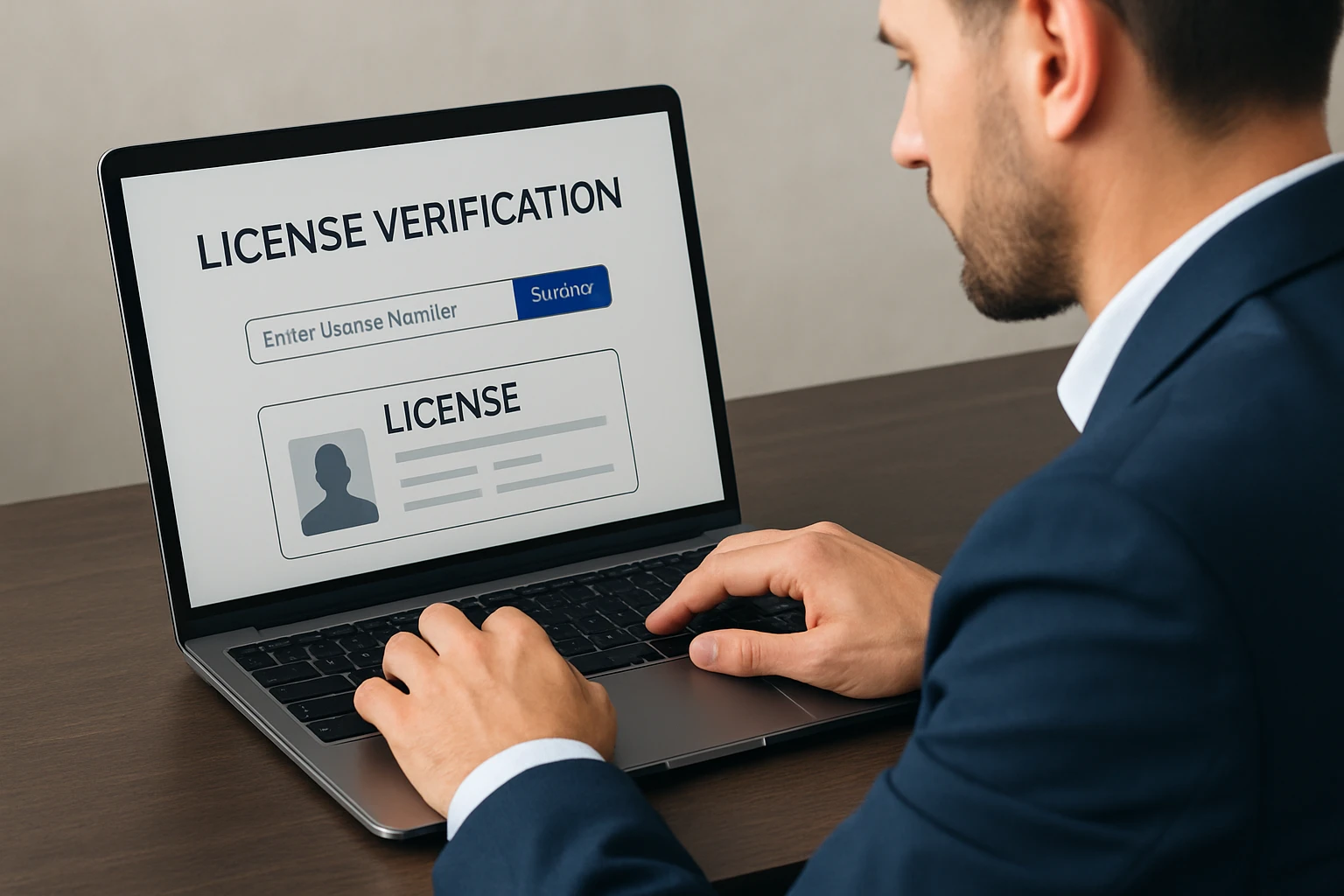
Ignore the badge in the footer for a moment. New Mexico RLD explicitly gives you a “Verify a License” path. Texas includes “Manage Your License” in its online flow. Florida’s portal is organized around licensing and online services rather than splashy claims. That is where you search. Use the regulator’s database first, then compare what you find against what the operator says.
Confirm the exact business name
Brand names and legal entities often differ. Search the legal name from the terms page, the privacy policy, or the footer disclosure. If the site says one name in the promo banner and another in the legal text, write both down. A mismatch is not automatic fraud, but it is a reason to slow the process and verify carefully.
Check status, renewal, and permit details
You want more than “exists.” Look for active versus expired status, renewal dates, restrictions, and any separate permit details. Some records show a business license but not the permit tied to the activity you care about. That gap matters.
| Field to match | What good looks like | What should stop you |
|---|---|---|
| Business name | Exact or clearly related legal entity | No match or unexplained mismatch |
| Status | Active or current | Expired, suspended, revoked, inactive |
| Dates | Recent renewal or valid term | Lapsed renewal window |
| Permit details | Relevant to the activity offered | General license with no clear tie to the offer |
A logo is marketing; a matching record is evidence.
Step 3: check disciplinary actions, complaints, and enforcement history
Scan disciplinary actions and citations
Once the license checks out, look for the ugly part of the file. New Mexico RLD features “Disciplinary Actions & Citations” and “Enforcement Actions.” Those pages exist for a reason. Search the business name, read the dates, and note whether the issue was minor, repeated, or recent.
Look for complaints and enforcement notices
Texas puts “Complaints and Enforcement” in the main navigation. That is your cue to look beyond the operator’s FAQ. You are not hunting for perfection. You are looking for patterns: unresolved disputes, recurring compliance trouble, or enforcement activity that clashes with the clean image on the landing page.
Use public reports as a reality check
Florida’s “Annual Regulatory Plans,” “Reports and Publications,” and “Open Government” sections help you understand how a regulator explains its priorities and actions. Even when an operator is not named directly, these public materials show how the office thinks about oversight, reporting, and enforcement. That context helps you judge whether a site’s promises sound grounded or too polished.
A clean homepage means nothing if the regulator has a messy file.
Step 4: read the rules before you chase the bonus
Find the official laws and rules page
Texas makes this easy with a “Laws and Rules” section. Florida’s plans and publications also help you read how the regulator frames its responsibilities. Do this before you obsess over the headline number. You want the rulebook that sits behind the license, not just the bright offer card.
Compare bonus terms with local restrictions
Bonus terms often matter more than the headline. Common trouble spots include wagering requirements, withdrawal limits, excluded games, and tight expiry windows. A no-deposit bonus that cannot be withdrawn under your local restrictions is not generous. It is bait with paperwork attached.
| Bonus term | What to check | Why it matters |
|---|---|---|
| Wagering requirement | How many times you must play through | Turns a big headline into a harder cash-out path |
| Withdrawal cap | Maximum cash-out from the offer | Limits the real value of the promotion |
| Game restrictions | Which bets or games count | Some offers exclude the activity you actually want |
| Eligibility rules | Location, payment type, and account history | Your account can be denied even after funding |
Separate marketing claims from legal obligations
Marketing says “instant,” “easy,” or “risk-free.” Legal obligations usually say something else: identity checks, disclosure rules, time limits, and account verification before withdrawal. Read the legal section with the same energy you give the offer itself.
Read the rules that apply to the license, not the headline that sold you the offer.
Step 5: confirm crypto deposit, identity, and withdrawal rules
Check what documents the site will ask for

Crypto feels fast. Verification rarely is. Before you deposit, find out whether the site asks for government ID, proof of address, or extra account checks before withdrawals. You want that surprise now, not after you hit a nice win and discover your account is frozen pending review.
Verify how deposits and withdrawals are handled
Check the accepted coins, supported networks, minimums, maximums, fees, and how withdrawals are approved. Confirm whether the site sends funds only to a verified wallet, whether it converts balances, and whether promo terms change when you use Bitcoin instead of card or bank transfer. Small print moves fast when money gets stuck.
Never send sensitive info through an unverified channel
Michigan’s Department of Licensing and Regulatory Affairs gives the right mindset here. It says it will never ask for credit card numbers or other personal information over the phone, by text, email, or letter. It also warns about fraudulent emails impersonating officials, including messages that reference “Action Required – LARA Enforcement Notice #83700” and ask for signatures or confidential information. Do not click. Do not reply with documents. Verify through the official Michigan.gov/LARA route and report suspicious activity to LARA-Safety@michigan.gov.
If the message creates urgency, treat it like a scam until you verify it yourself.
Step 6: monitor regulatory updates and official notices
Follow official news and update pages
Rules change. Service availability changes. Portals change. Texas includes Email Updates in its navigation. Florida has a News Room. New Mexico RLD keeps a Public Information Hub. Those are not decoration. They are your early-warning system.
Watch annual reports and public information hubs
Annual reports and public information pages show shifts in enforcement, priorities, and consumer warnings. They also reveal whether a regulator is tightening oversight or changing how it handles services and disclosures. A quick check once is good. A quick check before each major deposit is better.
Re-check before you deposit again
Make this a habit. Before you claim a new welcome deal or reload with Bitcoin, re-check the license status, scan for new enforcement activity, and confirm payment rules still match what you expect. A guide can help you spot offers faster, but the official record is where you confirm whether the offer is still worth touching.
Regulatory change can make yesterday’s good offer today’s bad bet.
Common mistakes to avoid
Trusting ads instead of records
Official portals separate online services, verification, disciplinary actions, and enforcement because those functions do different jobs. Use that structure. Generic landing pages blur everything together and hope you will not notice. If you cannot map the offer to an official record, stop there.
Answering unsolicited messages about your account
Michigan LARA’s warning applies well beyond Michigan: never share payment or personal information through an unsolicited phone call, text, email, or letter. This matters even when an offer like BetUS 200% Crypto sign-up Bonus up to $2,750 - Go betus crypyo bonus feels time-sensitive. Urgency is a sales tool. Sometimes it is also a scam tool.
Assuming one state’s rules apply everywhere
Texas and New Mexico make the point clearly. Regulated categories differ by jurisdiction, and a license in one place tells you very little about another without context. Your safest move is boring and fast: identify the place, find the regulator, verify the record, then read the rules tied to that place.
The fastest way to get burned is to skip the regulator page.
Do these checks before you deposit, and regulation and licensing becomes a five-minute filter instead of a costly surprise.
You are not trying to outsmart the bonus banner. You are checking jurisdiction, license status, enforcement history, rules, and payment controls before your Bitcoin moves.
Before your next claim or deposit, which part of this checklist will you verify first?
Additional Resources
Explore these authoritative resources to dive deeper into regulation and licensing.
Betting52.com For Smarter Bitcoin Choices
Betting52.com vets licensed Bitcoin-friendly sportsbooks and casinos, compares welcome and no-deposit crypto offers, and tracks rule changes so you can pick safer platforms faster.