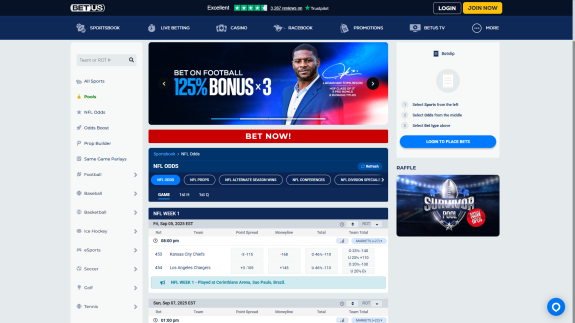
18+. Full T&C's apply. Sports bonus: 100% match up to $500. Casino bonus: 100% match up to $500. Enter promo code NEW200 at deposit and get up to a $1000 bonus. Valid on your first three (3) deposits. Available for all deposit methods. Minimum deposit of $50.
18+. Full terms apply. The Bet Back Bonus is available for new customers on first-time deposits of $50 or more. To redeem, select the offer in the cashier while completing your first deposit. Make your pick(s) in the Sportsbook and then select ‘Opt In to Use Your Bonus’. A Bet Back Bonus pop-up will display, select ‘Claim’ and then enter the risk amount to place your bet. If it wins, you keep your profits. If it loses, get 100% of your risk refunded as Free Play with only 1-time rollover. Free Play can then be used to place bets in the Sportsbook and earn cash. Additional T&Cs apply, please visit MyBookie to access the Help Center or contact Live Chat for more details.
The odds are often simpler than the screen surrounding them.
A boosted-odds banner fills half the homepage while a live match reaches the 68th minute. By the time the intended team total appears, 1.85 may have become 1.76—or the market may be suspended. Rather than rushing, it is safer to confirm the event, market wording, selection, and current price before staking.
Crypto sportsbooks add wallet balances, deposit prompts, token selectors, bonus counters, and network notices to an already busy layout. These controls matter at the cashier, but they rarely change the basic route: sport → competition → event → market. Start with the sport menu, narrow to the league or tournament, open the correct fixture, then scan tabs such as Main, Goals, Players, or Props. This is generally faster than chasing promotional tiles.
Map the betting interface
Separate betting tools from site controls before searching for markets.
On desktop, the betting area usually follows a left-to-right path: the sports menu selects a sport or league, the event list shows fixtures, and the market panel displays bets and odds. Selecting a price sends it to the bet slip, often docked on the right, where the stake and potential return appear.
These tools should not be confused with utility controls:
Top Crypto Sportsbooks for October 2026
BetUS
200% up to $1,000
Code: NEW200
18+. Full T&C's apply.
18+. Full T&C's apply. Sports bonus: 100% match up to $500. Casino bonus: 100% match up to $500. Enter promo code NEW200 at deposit and get up to a $1000 bonus. Valid on your first three (3) deposits. Available for all deposit methods. Minimum deposit of $50.
18+. Full terms apply. The Bet Back Bonus is available for new customers on first-time deposits of $50 or more. To redeem, select the offer in the cashier while completing your first deposit. Make your pick(s) in the Sportsbook and then select ‘Opt In to Use Your Bonus’. A Bet Back Bonus pop-up will display, select ‘Claim’ and then enter the risk amount to place your bet. If it wins, you keep your profits. If it loses, get 100% of your risk refunded as Free Play with only 1-time rollover. Free Play can then be used to place bets in the Sportsbook and earn cash. Additional T&Cs apply, please visit MyBookie to access the Help Center or contact Live Chat for more details.
Account: profile, verification, settings, and betting history
Wallet: deposits, withdrawals, balances, and crypto networks
Promotions: bonuses, boosts, and offer terms
Support: help articles, chat, and contact options
On mobile, the sports menu may sit behind a menu icon, while events and markets stack vertically. The bet slip often becomes a button or bottom drawer showing the number of selections. Wallet and profile controls commonly remain in the header or bottom navigation.
A clear layout reduces wrong-market clicks and makes live betting easier when prices move quickly. When comparing crypto sportsbook reviews and rankings, interface clarity deserves attention alongside market depth, fees, and payment options.
Narrow the fixture list first
Before using search, select the smallest useful fixture view. Live shows events already in play, while Today limits the schedule to the platform’s current calendar day. Upcoming is better for matches later in the week; choosing a sport, league, or tournament removes unrelated events and makes team names easier to scan.
A quick sequence keeps the list manageable:
Choose Live, Today, or Upcoming.
Open the relevant sport.
Add a league filter if the event list remains long.
Search only after those filters are active.
Check the site defaults before matching a fixture or comparing a price. The displayed day follows the sportsbook’s time zone, which may differ from local time and push a late match into tomorrow. Decimal, fractional, and American odds can make the same probability look unfamiliar. Language settings may translate country, league, or club names, so an English search term can miss the listed version.
Confirm the display settings
If a fixture appears missing, check the time zone, odds format, and language controls before assuming the market is unavailable. Resetting one default often makes the event recognizable.
Search in a fixed order
Start with the most specific name, then widen the search gradually.
A consistent sequence prevents long detours through league menus. Begin with the team or player name, since this is usually the fastest route to a single event. Try the surname, city, nickname, or a distinctive fragment rather than typing the full fixture.
Then apply the sport and date filters. Check whether the sportsbook uses local time, UTC, or a rolling period such as “Next 24 Hours.” Only browse competitions after those methods fail; league trees often separate qualifiers, women’s events, reserves, and regional divisions.
Use this order:
Search for a team or player.
Limit results by sport and event date.
Browse the competition or tournament list.
If an expected event remains missing, naming may be the problem. Search engines can treat Man Utd, Manchester United, and Manchester U. differently. Accented or localized spellings, sponsor-heavy tournament titles, national abbreviations, and labels such as “ATP Rome” versus “Italian Open” can also change results.
Before assuming a market is unavailable, clear old filters and refresh the event list. A filter left over from an earlier visit—especially Live, Today, or a specific league—can silently hide the fixture.
Open the full market menu
Featured odds are only the starting layer.
Most event pages open with a compact set of featured lines—usually the match winner, main handicap, and headline total. These are shortcuts, not the complete offering; the same odds may appear again within the full market list.
Read the market groups
Below the featured block, wagers are commonly grouped as totals, handicaps, player props, periods, and specials. Labels vary: “game lines” may combine spreads and totals, while quarters, halves, sets, or innings contain period-specific bets. A number beside a group title often indicates how many selections remain hidden.
Decode the expansion controls
Look for chevrons, plus signs, Show more, All markets, or tabs above the prices. On mobile, a horizontal category strip may need to be swiped before every group becomes visible.
A reliable check includes:
Expanding each group rather than stopping at the featured panel.
Checking period filters such as “Full game” or “First half.”
Clearing “Popular” or “Main markets” filters that suppress smaller categories.
Less prominent options often sit under Props or Specials rather than the sport’s main lines. The same controls are especially useful when searching for niche sports markets. Similar-looking bets should still be checked for settlement scope: a full-game total and first-half total are separate markets, while greyed-out rows may be temporarily suspended rather than unavailable.
Step 5
Verify What the Price Actually Covers
Common assumption
“Match winner” always means the team that advances.
What to check
It often settles on regulation time; “to qualify” includes extra time and penalties.
Why it matters
A drawn match can lose the first bet while the advancing team wins the second.
Common assumption
“Moneyline” always removes the draw.
What to check
Not necessarily: some sportsbooks use it for a three-way regulation result.
Why it matters
Check whether a draw is listed. A two-way moneyline usually handles a tie under stated rules.
Common assumption
A team bet shown under a fixture covers the full game.
What to check
Period tabs may limit settlement to the first half, quarter, or period.
Why it matters
Later scoring does not rescue an earlier-period wager.
Common assumption
All totals include overtime.
What to check
Some include overtime; others settle on regulation time only.
Why it matters
The same 2.5 or 210.5 line can therefore represent different bets.
Final check
Use a five-point price check
Before adding a selection, confirm:
Selection name: team, draw, over, under, or qualification. Line: handicap or total, including the sign. Period: full game, half, quarter, or period. Settlement scope: regulation only, or overtime and penalties included. Current odds: the displayed price can move after the market opens.
When using an app to compare sportsbook odds, all five fields should match—not merely the fixture and team—before choosing the better price.
Use the bet slip as a final check
Confirm every wager detail before submission
Adding a selection opens the bet slip, but it does not mean the intended wager has been built correctly. Treat the slip as the last navigation screen before placing the bet.
Confirm five details:
Event: the correct teams, players, or race
Market: including period, handicap, total, or settlement scope
Pick: the exact outcome selected
Odds: the current price, not merely the price first seen
Stake: the intended amount and currency
A single applies the stake to one selection. A multiple combines two or more selections; every leg generally has to win, and one losing leg can defeat the entire wager. Some interfaces automatically switch formats as selections are added, so the active tab deserves attention.
Live markets may become suspended, while changed odds can trigger an acceptance prompt. A price movement is not necessarily an error, but it should be reviewed rather than accepted automatically.
Remove duplicate, stale, or accidental selections before entering the stake. Finally, wallet balances, deposit buttons, and bonus toggles only control funding or promotional use. They do not confirm that the event, market, pick, or odds are correct.
Make repeat visits faster
Saved shortcuts remove much of the filtering required on a return visit. Favorite regular teams or events, pin frequently used leagues, and reuse recent searches when naming is consistent. Keep the list selective; too many favorites recreate the clutter they were meant to avoid.
Use My Bets to check open wagers and cash-out availability, while bet history is better for settled results and previous selections. These pages are more reliable than trying to reconstruct a wager from memory.
On mobile, a few habits help:
Pin only the competitions checked each week.
Clear stale searches and expired favorites.
Close the bet slip drawer before browsing another event.
Recheck filters after switching sports or returning from a notification.
A reliable 30-second routine beats frantic clicking. First, set the preferred layout, odds format, and prematch or live view. Confirm the sport and competition, then open the correct event. Choose the market group and read the selection’s scope—full game or period, overtime included or excluded, and any draw condition—alongside the current odds.
Before staking anything, inspect the bet slip for the event, market, pick, price, stake, and wallet or currency. A no-submit practice run builds familiarity without risking funds. Real speed comes from repeating the same sequence, not from skipping verification when prices move.
Top Crypto Sportsbooks for October 2026
BetUS
200% up to $1,000
Code: NEW200
18+. Full T&C's apply.
18+. Full T&C's apply. Sports bonus: 100% match up to $500. Casino bonus: 100% match up to $500. Enter promo code NEW200 at deposit and get up to a $1000 bonus. Valid on your first three (3) deposits. Available for all deposit methods. Minimum deposit of $50.
18+. Full terms apply. The Bet Back Bonus is available for new customers on first-time deposits of $50 or more. To redeem, select the offer in the cashier while completing your first deposit. Make your pick(s) in the Sportsbook and then select ‘Opt In to Use Your Bonus’. A Bet Back Bonus pop-up will display, select ‘Claim’ and then enter the risk amount to place your bet. If it wins, you keep your profits. If it loses, get 100% of your risk refunded as Free Play with only 1-time rollover. Free Play can then be used to place bets in the Sportsbook and earn cash. Additional T&Cs apply, please visit MyBookie to access the Help Center or contact Live Chat for more details.
Tony is the founder and author behind Betting52, where he writes about crypto sports betting, offshore sportsbooks and the wider world of online sports betting. His work covers crypto sportsbook reviews, Bitcoin and cryptocurrency payment methods, betting bonuses, sportsbook comparisons, betting odds, markets and practical betting guides. Tony's aim is to make sports betting information easier to understand, helping readers research sportsbooks, compare their options and make more informed decisions before placing a bet. Alongside sportsbook and crypto betting content, he is interested in the technology, payment systems and security considerations shaping the future of online sports betting.